Do you know how your 401(k) retirement income projections are calculated?
Forbes post, “Six Key Charts That Prove Why There Is No Alternative To Pension Reform In Illinois”
Originally published at Forbes.com on January 28, 2020.
I’ve said it before: Illinois cannot continue kicking the can on its pensions. I’ve said repeatedly (and fellow soapbox-stander Adam Schuster repeated the message in the Chicago Tribune last week) that the state’s spending on pensions is costly, not only in terms of dollar amounts spent — over 25% of the state budget — but in terms of spending that ought to be spent on needs such as services for those with disabilities, the unemployed, students, and so on, but isn’t, because it’s going to pensions instead.
And I’ve lamented that Gov. Pritzker just doesn’t get it, most recently in an interview in which he said that stretching out the funding target was not off the table, and seemed to suggest interest in the CTBA “solution” involving Pension Obligation Bonds and a reduced funding target of 70%.
All of which prodded me to look at the largest of the state pension plans, the Teachers’ Retirement System, in more detail. This plan is, like the other main plans, about 40% funded, and its unfunded liability is 60% of the total. It is also notable in having cut the benefits for the Tier 2 workers most sharply, so that, given the valuation’s assumptions and funding method, the benefit that they accrue is, in total, less than their required contributions. (Direct state employees mostly participate in Social Security so that their pension is a supplement, not a replacement, and the State Universities System has quirks of its own, including a pure Defined Contribution option for new hires.)
And I plowed through the data in order to assess, how reasonable are these funding targets? And what can go wrong?
Now, current legislation dictates that the state must make contributions as a level percentage of pensionable pay, to reach a target of 90% funded in 2045, but the contribution schedule is actually slightly lower than this target now, and jumps up later, so in order to do my own calculations, I replicated (approximately and in a more smoothed manner) the contribution projections. There are also some finer details which I simplified but the basic concepts below should still be clear.
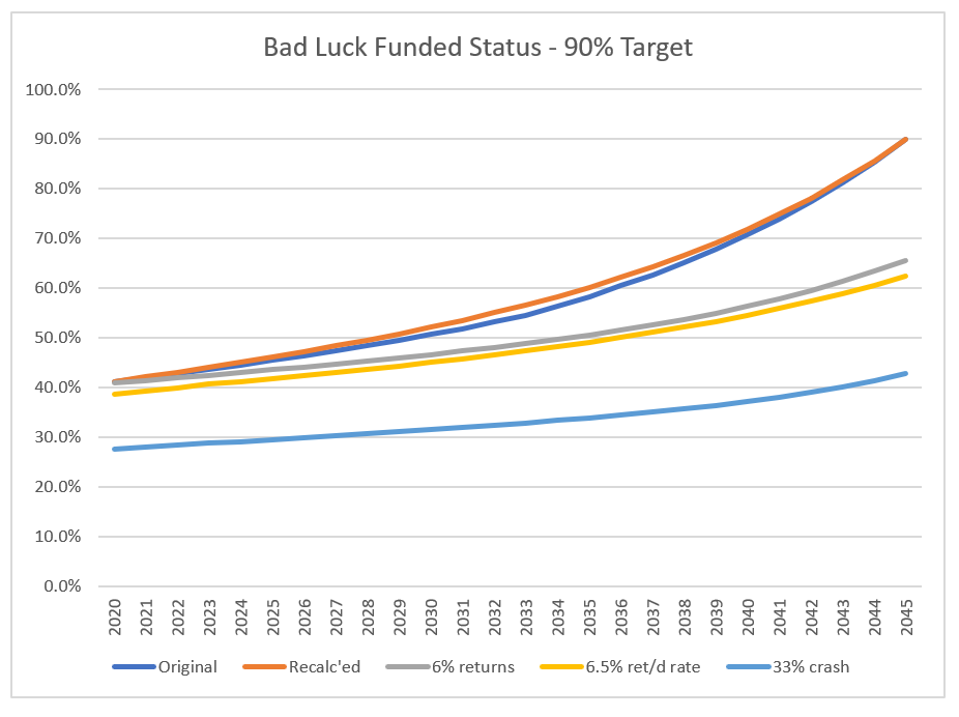
Chart One: what happens if there’s a run of bad luck?
I calculated three hypotheticals, in each case keeping the dollar amount of contributions unchanged:
In the first, I projected asset growth in the case that the 7% assumption turns out to be 6% instead. In the second, I assumed a long-term 6.5% return but also adjusted the liabilities to reflect the changes that’d be needed for a new valuation interest rate. And in the third, I kept the assumptions unchanged at 7%, but dropped the assets immediately by 33% to reflect a market crash.
Illnois TRS under “bad luck” scenarios
own work
Not good, eh? A drop to a 6.5% asset return/valuation interest rate assumption is not just reasonable but likely, and this keeps the plan from reaching anything close to its 90% objective — instead, only 62.5%.
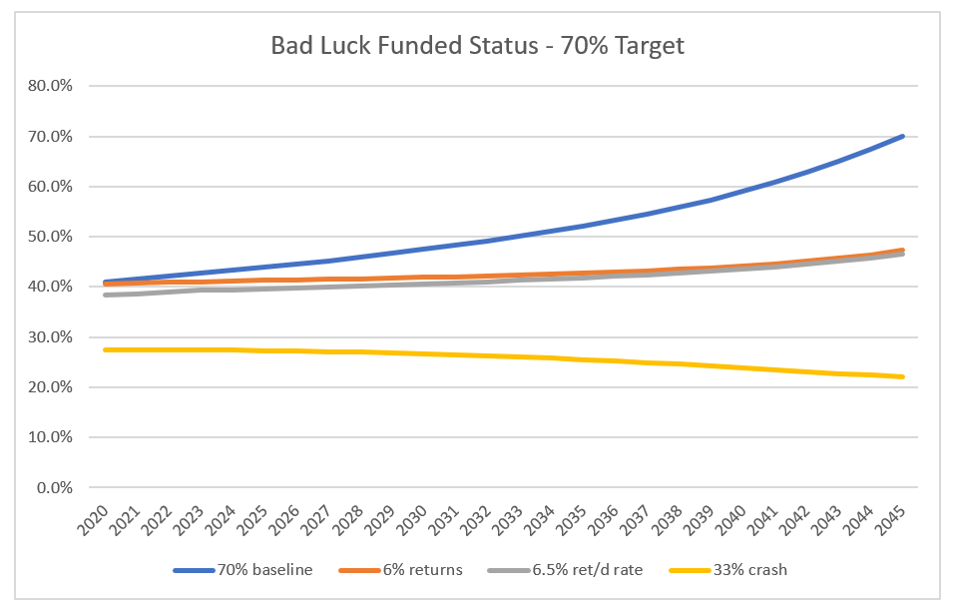
Chart Two: Bad luck with a 70% target
Illinois TRS hypothetical scenarios
own work
The colors shift because I’ve excluded the original target to illustrate the fact that setting a 70% target produces an even greater risk of poor funded status. (Note that the CTBA’s projections look different because of their POB proposal, and recall that I am, well, anti-POB, especially with respect to anyone who promotes pension obligation bonds as a form of “refinancing”.) In the wholly-realistic 6.5% discount rate scenario, it barely budgets from the present funded status, and maxes out at 46.6%.
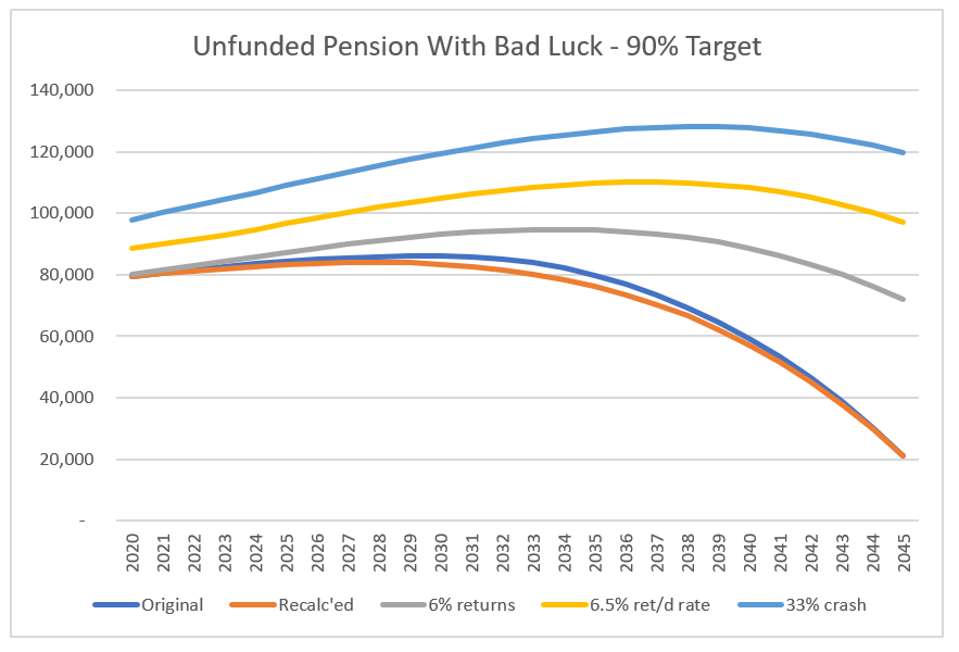
Chart Three: The effect on the unfunded pension liability, with a 90% target and “bad luck.”
Illinois TRS unfunding projection
own work
Note that while the funded status for the two low-return scenarios was similar, they diverge in terms of absolute pension underfunding. In the actuary’s current projection, the unfunded liability peaks in 2029 at $86 billion. With a discount rate drop, it peaks at $110 billion in 2037.
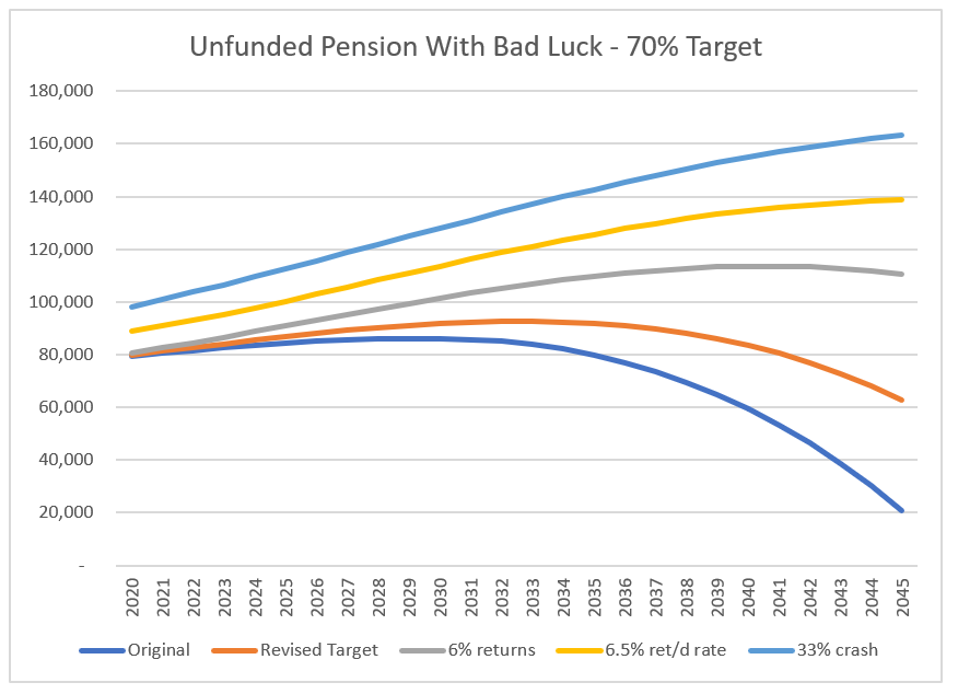
Chart Four: Unfunded pension liability with a 70% funding target.
Illinois TRS pension unfunding
own work
Yes, you see that right, in the scenario in which the plan targets a 70% funded level, and doesn’t adjust its contributions afterwards, the unfunded liability reaches $139 billion for the teachers’ plan alone in 2045, and has not yet peaked and begun to decline.
Are you starting to see my point?
Even with a 90% funding target, the state is at risk of liabilities growing year after year — or (not modeled here) even more money being spent on pension funding rather than daycare subsidies for low-income families, for example. And with a 70% target, of course, those numbers are even worse.
But wait, there’s more!
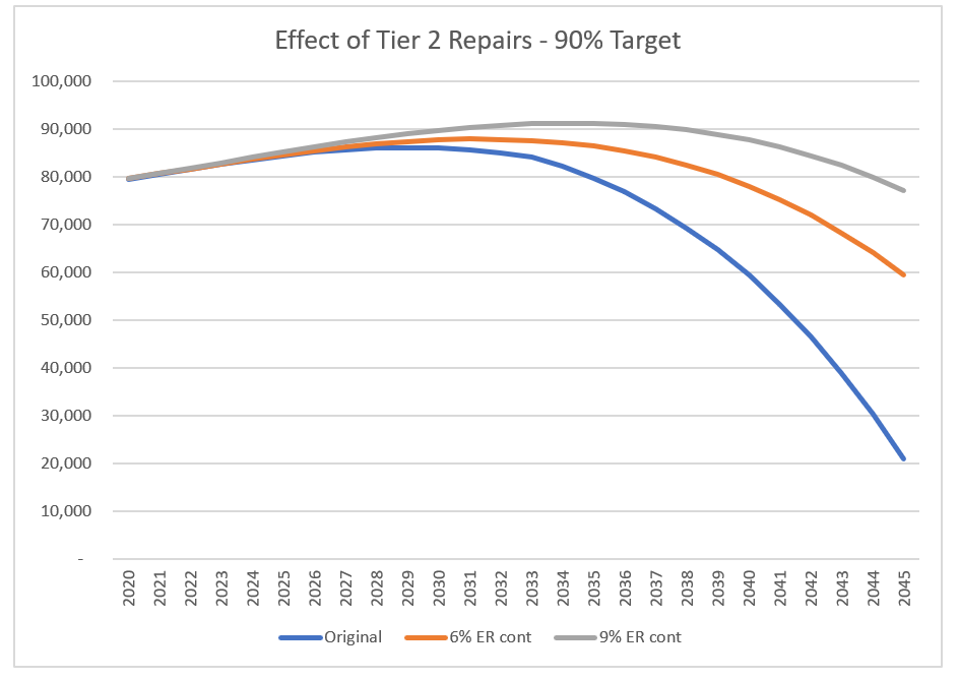
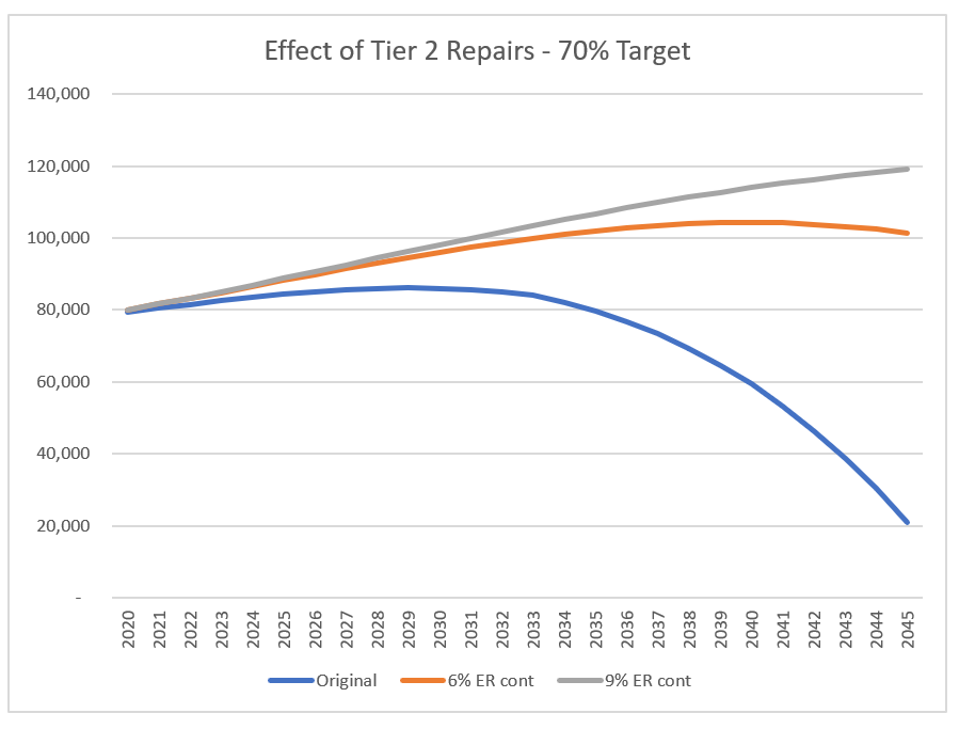
The final two of the six charts are an attempt to approximate the impact on the pension liabilities of a “repair” of the Tier 2 benefits. As it is, there is effectively no employer contribution. I modeled the impact of a 6% employer contribution (less than a Social Security contribution) and a 9% contribution, such as in a notional account plan (a “cash balance plan” in the private sector), along with the removal of the pay cap that is lowered every year in inflation-adjusted terms. This is approximative, but is a very conservative scenario.
Chart Five: Tier 2 “repairs” with a 90% target
Illinois TRS hypotheticals
own work
Chart Six: Tier 2 “repairs” with a 70% target
Illinois TRS Tier 2 hypotheticals
own work
To be clear, these are based on the baseline valuation, with “original” representing the original contributions for the 90% target.
Are these six charts enough? It was tempting to produce “worst-case” scenarios but those would be too easy to brush aside, and even these hypotheticals, intentionally made realistic, should be enough to make it clear that it’s not remotely reasonable to shrug off pension debt as something for the next generation to deal with.
Added next-day comments:
I’m often asked, “how long until the plan runs out of money?” And, in fact, that’s a fair quesiton to ask, with respect for the even-worse-funded Chicago plans, where they’re still making their way up the funding “ramp” and are so poorly funded that if they chicken out and markets have poor returns, they will become insolvent. In an article in September 2019, I explained some of the math; to take one example, if the mayor replaces the scheduled “ramp” increases for the municipal plan with inflatoinary increases instead, the plan becomes insolvent in 2027, even without adding in any “bad luck” scenarios.
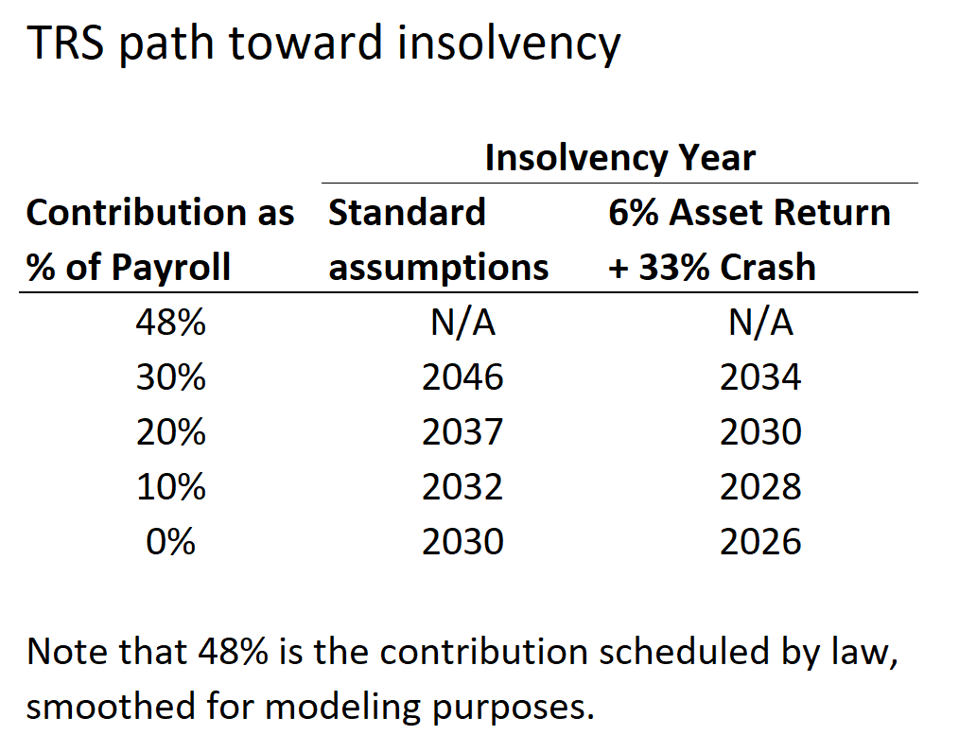
But there isn’t as dramatic an answer for the state plans — the 23% vs. 40% funded status ratios do make a difference. Nonetheless, I spent so much time typing up these numbers that I might as well make the most of them: the following table illustrates the insolvency year under the valuation assumptions, and a second scenario in which assets earn only 6% and there is a market crash.
TRS path towards insolvency
own work
If the state continues its current contribution level — which is, yes, 48% of pensionable payroll, and, yes, that’s a lot — the plan reaches 90% funding under current assumptions and avoids insolvency in the “bad luck” assumptions; however, its funded status is very shaky, staying 27% – 28% during the entire modeling period. And if the state were to drop its contribution down to significantly lower levels, then the plan would end up insolvent in either scenario.
Sadly, though, I doubt this table will persuade any of the politicians who need to be persuaded, many of whom would likely say, if off the record, “what’s wrong with insolvency anyway? We’re paying for the benefits our fathers and grandfathers promised; why not demand the same of our children and grandchildren?”
And one final comment: none of these scenarios take into account another likely issue in Illinois, that of declining population. A contribution of 48% of pensionable payroll directed almost entirely at paying off past debt, will grow to even higher levels, as a percentage of pensionable payroll, if the number of teachers declines over time in line with the number of residents. That’s not pretty, either.
December 2024 Author’s note: the terms of my affiliation with Forbes enable me to republish materials on other sites, so I am updating my personal website by duplicating a selected portion of my Forbes writing here.
Forbes post, “How To Achieve A Fair Public Pension Reform In Illinois: The Target Benefit Pension Plan”
Originally published at Forbes.com on January 23, 2020.
I’ve said repeatedly in the past that the state of Illinois should, going forward, adopt a combination of implementation of Social Security plus a defined contribution benefit — with the latter ideally in the form of a “collective defined contribution” in which the applicable unions or other entities provide protection against outliving benefits without the need for the costly guarantees of immediate/deferred annuities (or minimally a Wisconsin-style risk-sharing system), and with the latter also vesting at the much younger service levels that the government requires for private-sector plans rather than the 10 years that’s required for Illinois teachers. To refuse to reform pensions sucks up state spending that is sorely needed for other purposes. Today, the Chicago Tribune even published my opinion on the matter, though not with my byline, in a commentary titled, “Improve Illinois for you and your neighbors by supporting pension reform,” which restates my claim yesterday when the author, Adam Schuster, wrote,
“Illinois’ ever-growing pension spending is already crowding out core government services. The state spends about one-third less today, adjusted for inflation, than it did in the year 2000 on core services including child protection, state police and college money for poor students. Cuts hurting our state’s most vulnerable residents came as pension spending increased by 501%.”
That’s a crucial step one. And, yes, as I did yesterday, I’ll get on my soapbox repeatedly trying to make this happen. (And, yes, it also requires that we figure out how to make “collective defined contribution” plans work in the United States, which is a whole ‘nother soapbox having to do with multiemployer pension reform.)
But what about the existing employees? It’s true that their benefits could be reduced to some degree without too much pain, or, put another way, they can share the pain in a fair way — namely, by increasing retirement ages, capping pay (with a true CPI adjustment year-over-year), and capping COLA-eligible benefits, or benefits entirely, to impact only the upper-income retirees.
Yet that’s only a second-best solution. It still leaves Illinois lawmakers tempted to play the re-amortization game, to defer funding pensions, to continue to think of pensions as a business they should be in, when they have proven repeatedly that they can’t be.
Yet simply freezing benefits and giving existing employees the same DC benefit isn’t the right approach either. If that’s all pension reformers can offer, persuading the legislature — and the public — to support pension reform and a constitutional amendment would be a difficult task indeed.
To begin with, a DC benefit (especially with low vesting requirements) can never provide a full-career benefit as generous as that of a DB benefit for the same amount of money spent (especially when the vesting requirements for the latter are so strict) simply because the DC contribution provides much more of a benefit, comparatively, to job-changing workers. A teacher who leaves before vesting for another occupation or another state doesn’t just get nothing, but loses out by not even getting interest on the refunded mandatory employee contributions. Even teachers who leave after vesting but are still young will have small benefits, because they aren’t indexed for inflation, that is, for the increase in their pay over the rest of their working lifetimes, in the way that DC benefits implicitly are. Teachers collecting generous benefits at retirement age do so not just because of genereous state contributions but also on the backs of those who worked only a partial career before leaving teaching, or leaving the state.
But beyond that issue, the nature of backloading complicates things further. Due to the time value of money, the value of a dollar of benefit accrued at age 50 or 60 is worth far more than the same benefit accrued at age 20 or 30. Switching from one system to the other blindly is not equitable to those involved. (At the same time, someone switching into a defined benefit system from a defined contribution system at an older age — assuming they reach the vesting requirement — is much better off.)
But that doesn’t mean that employees can never be transitioned over! Instead, you need to take a different approach: provide extra contributions for the affected employees to help them reach a fair and reasonable target retirement benefit.
It’s called a target benefit plan.
Huh?
Here’s the IRS description:
“A target benefit plan is a defined contribution money purchase pension plan under which contributions to an employee’s account are determined by reference to the amounts necessary to fund the employee’s stated benefit under the plan. The benefit formula under a target benefit plan is similar to that under a defined benefit plan. However, the actual benefit that the participant will receive will be the account balance which will vary from the stated benefit based on investment performance. Thus, the stated benefit is a ‘target benefit.’”
In other words, in a target benefit plan, employer contributions to a worker’s retirement account increase each year in a manner that is roughly equal to the increase in value that worker would see in a traditional defined benefit pension plan. Implementing a target benefit plan for existing workers makes it possible to transition workers from a defined benefit to a defined contribution plan without losing out on the backloading effect of future accruals.
Now, to be sure, this sort of plan, with few exceptions, largely exists on paper only, at least in the United States. But in two countries with highly-rated retirement systems, this is the norm. The Netherlands, ranked number one by Mercer, has standardized contributions that range from 4.4% for ages 21 – 25 to 26.8% at ages 65 – 67. Switzerland, with a “B” rating, has four brackets from 7% to 18%.
Of course, I can hear the objection already: “there’s no way Illinois can afford to pay down its pension liabilities and make DC contributions at the same time!” But that is precisely what Illinois must do: pay down old debt while at the same time ending the practice of building up new debt for the next generation.
December 2024 Author’s note: the terms of my affiliation with Forbes enable me to republish materials on other sites, so I am updating my personal website by duplicating a selected portion of my Forbes writing here.
Forbes post, “The High Cost Of Rejecting Public Pension Reform In Illinois”
Originally published at Forbes.com on January 22, 2020, and still relevant 4 years later.
Once more, from the top: here is why public pension reform matters.
In December, I cited a report by the Chicago Tribune that, due to lack of funding, 20,000 adults in Illinois with cognitive disabilities were on a waitlist for group homes or day programs, waiting seven years or longer, due to lack of funding.
Earlier this month, the Trib reported that, due to the end of work-requirement waivers for SNAP/food stamps, social services agencies were scrambling to place recipients in job training or volunteer programs.
Here’s a key excerpt:
“Basic processes to help with the administrative burden have yet to be put in place, state caseworkers say. For example, there is no efficient way to report volunteer or training hours completed outside of state-sanctioned programs, so people will have to do so monthly in person at benefits offices, where waits can stretch longer than two hours, said John Mitchell, an officer with AFSCME Local 2858, which represents caseworkers in northeast Cook County.
“Understaffed benefits offices also haven’t prioritized connecting people with employment services as they’ve dealt with a backlog for processing SNAP applications that was so bad that the federal government threatened to suspend funding, Mitchell said.”
Last week, the Tribune reported that the University of Illinois system was raising its tuition after having frozen it for the past six years. The increases are modest, all things considered, but here is the key paragraph:
“Residents long have complained that U. of I., the state’s flagship, is too expensive and does not offer enough financial aid. University data shows all three University of Illinois schools remain among the priciest in their peer groups, even though other schools raised their prices during Illinois’ tuition freeze.”
And this week, Chicago Mayor Lori Lightfoot announced plans for an anti-poverty summit “to marshal resources from the city, business community and philanthropic groups to rescue Chicagoans ‘trapped in the throes of generational poverty,’” as reported at the Chicago Sun-Times. How’s she funding this?
“The $250 million earmarked for Lightfoot’s ‘Invest South/West’ program is ‘re-prioritized money already in the pipeline’ from tax increment financing; the moribund $100 million Catalyst Fund; the Small Business Improvement Fund; and the share-the-wealth Neighborhood Opportunity Fund generated by developers paying a fee for permission to build bigger and taller buildings downtown.”
But at the same time, the city of Chicago issued its new “refinancing” bonds, in which the city found $210 in cash up front due to lower rates — and, it turns out, those rates were not favorable solely because of a lower interest rate environment, in general, but because the city legally committed the right to future sales tax revenue it has coming from the state, so that investors will receive their money even if the city goes bankrupt and has to default on other loans and cut city services. And it was only possible to do so because of a last-minute back-room provision inserted into the 2017 budget in the literal last hours of the legislative session. (See this Wirepoints report for details.)
The list goes on: insufficient spending on childcare subsidies for low/moderate-income parents . . . insufficient state spending on education, placing the burden on local property tax payers . . .
These are all areas where there is widespread agreement that the State of Illinois falls short.
At the same time, of course, however eager the Democrats currently in power in Illinois (that is, controlling the governorship and State House and State Senate, with supermajority control over the General Assembly, as Illinois labels it) are to raise taxes through a graduated income tax, skeptical voices caution that it simply isn’t possible to raise taxes however much you’d like to boost spending however much you’d like — even if you claim those increases will be limited to “the rich” (which is always defined as “everybody with more money than your audience at any given point in time). Not only will it raise the ire of those taxpayers, but increasingly many of them will find somewhere else to live.
And, yes, one would like to imagine that there’s an easy solution to these woes, whether it’s the perennial pledge to cut wasteful spending or the dream to find new sources of free money (in Illinois’ case, pot and gambling). But Illinois politicians have believed in the promise of free lunches for far too long.
And this is why public pension reform matters: 25.5% of Illinois’ spending is going to its state pension funds. Once the city has made it up to the top of its funding ramp, it will be spending 18% of its revenue on pension contributions, assuming its revenue projections are not overly optimistic. (See here for the contribution schedule — $2.2 billion in 2022 — and here for the revenue projection which I’ve increased by two years’ worth of inflation.) And these percentages could go higher if the state and city are forced to unwind the “Tier 2” pension cuts as a result of court cases or political pressure.
It should be obvious: pension reform is not about trying to fleece public employees and retirees.
Instead, it’s quite simple: had the state not promised more in pension benefit accruals each year than they funded through contributions at the time, that money would be available to spend on all these needs. And if Gov. Pritzker, the General Assembly, Major Lightfoot, and public union leaders were to forge a consensus for an amendment which would permit pension reforms, some portion of that 25.5% and the 18% would be freed up to spend on these needs.
December 2024 Author’s note: the terms of my affiliation with Forbes enable me to republish materials on other sites, so I am updating my personal website by duplicating a selected portion of my Forbes writing here.
Forbes post, “Is Gov. Pritzker Clueless Or Reckless On Pensions?”
Once again, Pritzker talked about pensions in an interview. Once again, he doesn’t get it.
Forbes post, “Was The Illinois Constitution’s Pensions Clause Meant To Be A Suicide Pact? Three Important Pieces Of Historical Context”
Originally published at Forbes.com on January 15, 2020.
On twitter, I joked that I was drafting an article I was tempted to call, “Beating a Dead Horse Into The Ground: More Historical Context On Pensions Than Any Reader Is Remotely Likely To be Interested In.” But — I’m sorry to disappoint you — I suspect this will not be the last time I address the context of the pension clause, especially as it drives my conviction that it is indeed necessary to amend the Illinois constitution before pensions can be reformed, but that, no differently than the flat-tax-only provision of the Illinois constitution, the path is cleared for legislation if that happens.
So here are three key pieces of historical context to keep in mind with respect to this clause in the Illinois constitution which forbids any action which would “diminish or impair” pensions. (See “What The Illinois Supreme Court Said About Pensions – And Why It Matters” for a catch-up on the topic.)
First, the pensions clause was bipartisan. It’s easy to think of Illinois as a “blue state” in which the Democratic party has a lock on governance, but that clause, debated on over only the course of a single day, was principally sponsored by four Republicans — two judges, a lawyer, and a land developer — with 15 co-sponsors (yes, including Chicago Mayor Richard M. Daley) from both parties. Some sponsors believed, however mistakenly, that the clause would be the impetus for moving pensions towards full funding — that is, believing that, if legislators knew that future generations couldn’t escape pension funding by reneging on promises, they’d be more responsible about funding (I know, you can resume reading after you’re done laughing and I apologize if you’ve gotten coffee on your keyboard); others had no such illusions.
(For more historical context, an undated page at the Illinois Senate Democrats’ website provides links to multiple sources of further information, including a 2013 Chicago Tribune article, and a 2014 report which provides background on the 1970 clause and funding history since then.)
Second, although the five state systems had more or less the same funded status then as now (41.8% in 1969, according to that 2014 report, and 40% in 2019), the magnitude of the unfunded liability, the debt accrued as a result of promising benefits without funding them, has grown at an incredible rate in the past 50 years.
That same 2014 report cites an unfunded debt of $1.46 billion in 1970.
In 2019, the debt stands at $137 billion.
That’s an increase of 9,078%.
Is that perhaps a bit of an unfair comparison, because of inflation?
If we take into account inflation, that’s an increase of 1,354%.
Even if we take into account the increase in GDP in Illinois in this period, that’s an increase of 578%. Or if we look at increases in total personal income in Illinois, it’s an increase of 553%.
In other words, even in the most charitable way of massaging the numbers, the degree of unfunding is far, far higher than it was in 1970. (CPI data comes from the Bureau of Labor Statistics and economic data from the Bureau of Economic Analysis.)
What’s more, this is not merely due to failures to fund, or to demographic changes. Plan benefits were regularly increased, over and over again, until the legislature finally realized that fixes were necessary in 2011.
Consider the Teachers’ Retirement System. In 1971, the basic benefit formula was increased, the maximum benefit was increased from a range of 60 – 70% by age, to 75%, and early retirement reductions were eliminated for retirees with 35 years of service. In 1972, the cola was increased to 2% and in 1978, it was increased to 3%. In 1979, an early retirement program was established, the provisions of which changed and were renewed periodically in the coming years. In 1984, credit for up to one year’s accrual via sick leave was implemented and in 1988, employees could use sick leave credit from former employers. In 1991 and 1993 early retirement incentives were implemented. In 1998, the basic benefit formula was increased again. In 2003, teachers were permitted to use two years of sick leave to count towards pension accruals. In other words, the pension benefits being guaranteed in 1970 were considerably less than now.
And, third, legislators utterly lacked an understanding that pension liability is a real form of debt. In this, they weren’t alone. The landmark law requiring funding for private sector plans, ERISA, was passed in 1974. It took until 1985 for the FASB to issue regulations governing accounting for private sector pensions, in the form of FAS 87 and FAS 88.
As the 2014 report I cited earlier describes, for many years following the 1970 constitution, Illinois’ funding policy, if you can call it that, was to fund the benefits being paid out in any given year, a dreadful pyramid-scheme that only works if you’re indifferent to the consequences for future generations, or believe that economic and population growth mean that those future generations can easily manage the bills that will come due. Turns out, if those delegates and politicians in 1970 had believed that future population growth meant that there was no need to worry, that was about the last point in time in which they could reasonably believe this, as the decade from 1960 to 1970 was the last decade of meaningful population growth.
So, no, the Illinois pensions clause wasn’t meant to be a suicide pact. But it will turn out to be if we don’t change it.
December 2024 Author’s note: the terms of my affiliation with Forbes enable me to republish materials on other sites, so I am updating my personal website by duplicating a selected portion of my Forbes writing here.
Forbes post, “Is The Illinois Constitution’s Pension Protection Clause Truly The Will Of The People?”
Originally published at Forbes.com on January 9, 2020.
“Membership in any pension or retirement system of the State, any unit of local government or school district, or any agency or instrumentality thereof, shall be an enforceable contractual relationship, the benefits of which shall not be diminished or impaired.”
That’s Article XIII, Section 5, of the Illinois constitution approved by 57% of the 37% of voters who voted in a December 1970 special election.
Did voters know that they were binding future generations to a promise that legislatures could increase pension benefits at any point — which they did, repeatedly — but could never reduce them, not even with respect to pensions not yet accrued, regardless of how expensive those pensions would become?
Via an online database, I took a look at the reporting at the time in the Chicago Tribune. Various articles highlighted some of the key issues being debated in Springfield: “home rule” of cities, amount and types of taxes the state and cities would be empowered to raise, whether judges would be appointed or elected, whether the legislature should be selected via cumulative voting or single-person districts, among others. The new constitution eliminated the prior prohibition on gambling, which meant at the time that bingo games would be legalized, and included firearms-ownership rights. Delegates considered banning capital punishment, but this proposal was defeated. (See, among others, “Here’s What Illinois Con-Con Has Done,” by John Elmer, April 20, 1970; “Fate of Con-Con Largely in Hands of Daley, Observers Indicate,” John Elmer, Sept. 7, 1970; “Foes Forming To Destroy Con-Con Plans,” John Elmer, June 7, 1970.)
But the pension protection clause?
Nothing.
The only newspaper item in which this appears is a document titled, “Sixth Illinois Constitutional Convention Address to the People,” published on behalf of the delegates on Nov. 22, 1970, briefly explaining the document and the voting process, and asking for voter approval. This document says:
“The provisions of state and local governmental pension and retirement systems shall not have their benefits reduced,”
which, of course, fails to meaningfully inform the public that the document on which they are voting guarantees not only benefits accrued-to-date (as they might reasonably expect in comparison to private-sector pensions) but also benefits not yet earned, that is, for future service credits, as well as cost-of-living increases, generous early retirement provisions, etc.
And, again, this vote on the constitution offered Illinoisians the opportunity to decide on four separate items themselves rather than being subject to the decisions of the convention delegates. With respect to judicial election or appointment, single-member or cumulative-voting districts, the death penalty, and the voting age, voters were not constrained to an all-or-nothing, up-or-down vote. Not so with pension guarantees.
Now, perhaps one might say that this means that it was wholly noncontroversial that future accruals as well as past benefits should be protected. After all, the constitution delegates were chosen on a nonpartisan basis, at least on paper — in actual practice delegates were supported by the party machines of the party in power in one area or another, that is, Chicago vs. downstate, as they were the ones with the mechanisms to ensure voter turnout, rather than some idealized scene of local community leaders coming together. (See “State Constitutional Convention, ‘69: Big Issues at Stake for the Voters,” John Elmer, Sept. 22, 1969.) And in Illinois, home of “The Combine” and bipartisan corruption, it’s hardly necessary to have one-party dominance, for politicians to make decisions that are all about preserving their power without regard to the well-being of the people of the state.
What’s more, the writers of the state’s constitution included a means of amending the document via the collection of petition signatures — but they limited this only to amendments pertaining to the constitution’s Article IV, which has to do with the legislature: its composition, the redistricting process, the timing of its sessions, etc. An amendment to any other section of the constitution may only be accomplished through the legislature’s voting by three-fifth’s majority to place an amendment on the ballot, and then passage by three-fifth’s of those voting in the subsequent election.
All of which makes the statements of the Illinois Supreme Court, in its 2015 decision overturning the 2013 pension reform law, farcical (however true, in some legal construction, they may be):
“Article XIII, section 5, is in no sense a surrender of any attribute of sovereignty. Rather, it is a statement by the people of Illinois, made in the clearest possible terms, that the authority of the legislature does not include the power to diminish or impair the benefits of membership in a public retirement system. This is a restriction the people of Illinois had every right to impose. . . .
“The people of Illinois give voice to their sovereign authority through the Illinois Constitution. It is through the Illinois Constitution that the people have decreed how their sovereign power may be exercised, by whom and under what conditions or restrictions. Where rights have been conferred and limits on governmental action have been defined by the people through the constitution, the legislature cannot enact legislation in contravention of those rights and restrictions. . . .
“Article XIII, section 5, of the Illinois Constitution (Ill. Const. 1970, art. XIII, § 5) expressly provides that the benefits of membership in a public retirement system ‘shall not be diminished or impaired.’ Through this provision, the people of Illinois yielded none of their sovereign authority. They simply withheld an important part of it from the legislature because they believed, based on historical experience, that when it came to retirement benefits for public employees, the legislature could not be trusted with more (p. 22 – 24).”
Yes, in a legal sense, the Illinois constitution is, in a grandiose sort of way, The Will of the People. But one can’t help but feel that, in writing these words, the Court was mocking the powerlessness of the people of Illinois who had no real control over any of these decisions.
December 2024 Author’s note: the terms of my affiliation with Forbes enable me to republish materials on other sites, so I am updating my personal website by duplicating a selected portion of my Forbes writing here.