In 2005, Elizabeth Warren said saving for retirement was “easy.” Does she still believe that?
Forbes post, “Elizabeth Warren Wants To Cut The Value Of Your Retirement Account”
Originally published at Forbes.com on September 21, 2019.
So, as it turns out, Elizabeth Warren’s Social Security expansion proposal is not the only one of her plans to affect Americans’ retirement well-being. But the proposal of hers which will affect Americans’ retirement savings, in their 401(k)s and their IRAs and the funded status of their pension plans (which might be irrelevant for single-employer traditional pension plans guaranteed by employers but matters considerably for multi-employer plans), is tucked away in a component of her platform with the harmless-looking title, “Empowering Workers Through Accountable Capitalism.”
It’s a proposal that’s a repeat of legislation she proposed in 2018, the “Accountable Capitalism Act,” which, as it happens, I dug into at the time on another platform. The most nebulous part of the proposal is the notion that large corporations would be obliged to pursue the “best interests” of a long list of entities, not merely shareholders but also employees, suppliers, customers, the local communities where the companies locations are based, and others, with the fundamental premise that such a corporation “shall have the purpose of creating a general public benefit.” But however much writers such as Kevin D. Williamson decried this as “the wholesale expropriation of private enterprise in the United States” this all appears to be aspirational and symbolic, without any enforcement mechanism included in the legislation, or administrative agency named to ensure the corporation is indeed “creating a public benefit.”
What is far more concrete is a requirement that such “United States corporations,” that is, those with over $1 billion in revenue, would be obliged to bring onto their boards of directors, representatives elected by employees, at a minimum ratio of 40% of the total board members. The website declares:
“Elizabeth’s plan gives workers a big voice in all corporate decisions, including those about outsourcing, wages, and investment,”
and references Germany as an example of a country with a similar approach.
In an abstract way, of course, directors are bound to represent shareholders; if 40% of board members no longer represent the shareholders, than this is, in effect, taking away from shareholders the ownership of 40% of the company. But this is more than just an abstract impact. How much of a difference would it make?
In an analysis of Warren’s proposal in 2018, Matthew Yglesias at Vox cites research that ties the German “codetermination” requirement, as it’s called (which has required employee representation in many industries in 1951 and universally in companies with over 2,000 employees in 1976), versus the American principle of maximizing shareholder value, as responsible for the considerably greater growth of share prices in the U.S. compared to Germany and countries with similar requirements. Based on these differences, Yglesias writes, “share prices could fall by 25 percent.”
But this is fine for Yglesias because, he claims, it’s only the ultra-rich who own stock: the richest 10% own 81.4% of the stock market, and the top 1% own 38% of the stock market wealth. But the study he derives these figures from focuses exclusively on household wealth based on a government survey, the Survey of Consumer Finances, so it excludes from its calculations “wealth” owned by individuals in the form of promised future pension benefits (and backed by pension funds), and takes no interest in the amount of stock market wealth owned by nonprofits or other institutions. Take a look at the estimates from Pensions & Investments: 80% of stock market equity is held by institutions: that means, mutual funds, pension funds, 401(k)s, and the like. In particular, 37% of stock is owned by retirement accounts; when subtracting out foreign owners of US stock (26% of the total), 50% of US-owned US equities are owned within retirement funds. And it should go without saying that there is no way to “punish” the wealthy by causing the value of only the stock they own to go south while somehow protecting the 401(k) and other retirement accounts for the rest of us. It’s cutting off your nose to spite your face and, as someone with a 401(k) account, I’d really prefer not to do this.
December 2024 Author’s note: the terms of my affiliation with Forbes enable me to republish materials on other sites, so I am updating my personal website by duplicating a selected portion of my Forbes writing here.
Forbes post, “Bernie Sanders Wants A Scandinavian-Model Social Insurance System. Sure, Why Not? (For Retirement Anyway)”
Originally published at Forbes.com on September 19, 2019.
Last week, at the most recent Democratic presidential-primary debate, Bernie repeated the defense of Democratic Socialism that he’s given in the past, in response to a linkage of his beliefs to socialism as practiced in Venezuela:
“In terms of democratic socialism — to equate what goes on in Venezuela with what I believe is extremely unfair. I’ll tell you what I believe in terms of democratic socialism. I agree with what goes on in Canada and Scandinavia, guaranteeing health care to all people as a human right. I believe that the United States should not be the only major country on Earth not to provide paid family and medical leave. I believe that every worker in this country deserves a living wage and that we expand the trade union movement.”
Now, in those European countries who have a much heavier emphasis on social welfare provision, they call their model “social democracy” because they know full well that “socialism” has a specific meaning that is not merely the extensive provision of social insurance/social assistance benefits in a capitalist economic system.
And in a prior article on another platform, I observed that even in countries with the most generous of medical benefits by the state, the state provision appears to top out at 85%, with the remaining 15% paid by individuals out-of-pocket or via private health insurance; the proposals of Sanders and others for “Medicare for All,” in which (unlike the current Medicare program) all care is covered without any cost-share, go well beyond this.
But the greater irony is what retirement systems look like in the three countries of Scandinavia, which are – really – not what you’d expect at all for countries that are popularly understood to be paradises of income redistribution.
(As with my prior article on basic retirement income systems, this information comes from the Country Profiles in the OECD Pensions at a Glance 2017 and Social Security Programs Throughout the World, where not otherwise specified.)
Denmark
Denmark, as it turns out, has a Basic Retirement Income system, too. Similar to the Netherlands, the benefit is prorated based on length of residency, requiring 40 years of residence for the maximum benefit. It’s payable at age 65, increasing to age 67 by 2022 and then age 68 in 2030.
The basic benefit is DKK 75,924 per year, or about $11,200, with a means-testsed supplement of up to DKK 83,076 for singles or DKK 41,436 for married or cohabitating recipients ($12,300 or $6,100), for a potential maximum benefit of $23,500 or $17,400, but with a phase out that’s similar to the Australian system, reducing the supplement with earnings of $13,000, reducing the basic benefit at $48,800, and eliminating all benefits at $85,300, at current exchange rates. (See the local website, for which I relied on web browser translation to read, for details.)
In addition, there’s what’s called the “social insurance” pension, old-age pension, or ATP, and this is really an odd duck, as far as what we’re used to in the U.S. It’s a contributory system, but with a flat contribution, variable only by hours worked, not by pay. The contribution works out to 270 kroner per month, split 2/3 employer, 1/3 employee — or about $13 per month per employee. And benefits are paid out in line with contributions paid in, based on the investment income the fund earns.
But the bulk of Danish workers’ retirement income comes from employer-provided DC plans. These are not 401(k)s; the employer pays the whole contribution, and it’s technically voluntary, but generally the result of collective agreements, and, as in the Netherlands, about 90% of employees have these. OECD reports that contributions are typically 12% of pay for lower-income workers, and up to 18% for higher income workers, because the state pension replaces proportionately less of their pay. Some 20-25% of this amount goes to fund other types of insurance, such as disability and survivor’s benefits.
And Danish workers are protected from investment risks, not by any sort of magic, or governmental guarantees, but by something that’s well-nigh incomprehensible in the United States: the DC plan contributions are invested in deferred annuities.
Norway
Remember Bush’s individual account proposal for Social Security? Well, the Norwegians were paying attention. Sure, this isn’t a system of funded accounts, but benefits are based directly on contributions in a “notional defined contribution” formula, after a 2011 pension reform.
Individual workers contribute 8.2% of pay, and employers 14.1%; this funds old age retirement benefits as well as disability and maternity.
Standard Social Security benefits are based on accruals of 18.1% of pay, up to a ceiling of NOK 708,992 (about $79,300 at current exchange rates). These accruals grow at the rate of annual average wage increases (rather than based on investment income or a set interest rate), and at retirement, are converted into benefits based on a life expectancy factor which varies each year based on life expectancy in that year. For years of unemployment, or parental leave, amounts are credited based on hypothetical earnings.
Low income workers receive a minimum benefit of NOK 175,739 ($19,700), prorated if one’s work history (including years of childcare, jobseeking unemployment, and mandatory military/civilian service) is less than 40 years, payable at age 67.
In addition, employers are obliged to contribute 2% of pay into a private-sector Defined Contribution benefit; at retirement, a private-sector annuity is purchased with the accumulated funds.
Sweden
Sweden also reformed its system into a notional-account program in 2011. Employees pay 7% of pay, employers 10.21%, up to a ceiling of SEK 504,375 ($52,000). Of this, 14.88% is allocated to the notional-accounts system and 2.33% to a true Defined Contribution account. As with Norway, the notional accounts are increased by economy-wide wage increases, as well as the reallocation of accounts of those who have died, within that age cohort. At retirement, the benefit is annuitized based on age-appropriate life expectancy and a real discount rate of 1.6% (that is, an after-inflation rate). Benefits are increased more-or-less in line with inflation after retirement but with adjustments for any imbalances in the “notional fund.”
Again, as with Norway, there is a minimum benefit, in this case SEK 96,912 (single) or SEK 86,448 (married); that’s $10,000 or $8,900. (There are also supplemental benefits that are not considered part of this system.)
For the portion of the contribution that funds a true private sector Defined Contribution account, workers choose their fund provider themselves, and can elect a traditional or a variable annuity at retirement.
In addition, most workers (90%), blue- and white-collar, are a part of nationwide collective agreements which include a further Defined Contribution account, called the ITP (or ITP1 or ITP2 or ITPK). At least half of this must be invested in “insurance” (that is, a deferred-annuity type investment), with the other half left to participants to choose.
Replacement Rates
The OECD has helpfully done the math to boil down these benefit provisions into a “replacement ratio” which is also available for all OECD countries, including the United States, where the OECD assumes that a worker receives a 9% Defined Contribution supplemental benefit, including self- and employer-provided average benefits.
All of which adds up to the following calculation (again, not mine, theirs):
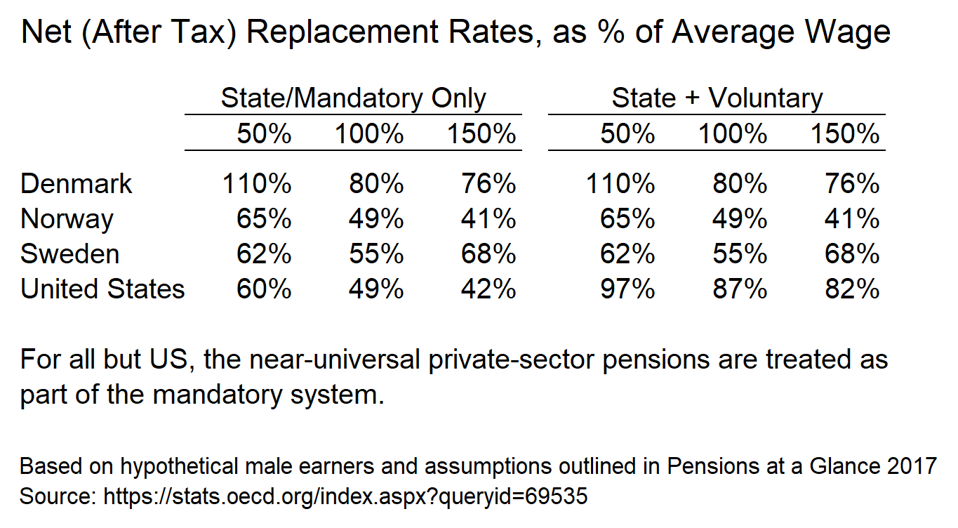
Scandinavian pension comparisons
data from OECD Pensions at a Glance 2017
Yes, the Danish system with its very generous Basic Retirement Income comes out highest. But the Norwegian and Swedish systems, even including mandatory employer benefits, are not exceptionally higher than US Social Security (except for Swedish upper-income workers, due to the private sector system that’s treated as mandatory), and when the US 401(k) system is added in, American retirees come out on top.
So, by all means, let’s reform our system to reflect the Scandinavian system. Which one do you choose?
December 2024 Author’s note: the terms of my affiliation with Forbes enable me to republish materials on other sites, so I am updating my personal website by duplicating a selected portion of my Forbes writing here.
Forbes post, “Farewell, FICA – And Other Basic Retirement Income Details”
Originally published at Forbes.com on September 19, 2019.
Since I’m on my soapbox again about Social Security reform, here are some questions and answers on my preferred approach, a Basic Retirement Income.
How’s it paid for?
To start with, the key point is how it’s not paid: a move to a new Social Security system would enable ourselves to eliminate the FICA tax.
After all, there’s general agreement that the FICA tax is regressive, hitting low-wage earners at a greater rate than wealthy folks who have exceeded the year’s ceiling. For this reason, a “payroll tax holiday” is a popular recession-fighting move (proposed by the Trump administration to ward of a feared recession now, and implemented in 2011 – 2012), but because of the need to keep money flowing into the Social Security Trust Fund, Congress redirects an equivalent amount of funds from general revenues (that is, borrowed funds) into the Trust Fund.
Eliminating the FICA tax, and funding a Basic Retirement Income with general federal revenues (for instance, a tax hike on all income) would remedy this issue.
And, in fact, of the three systems I profiled earlier this week, the Netherlands has a payroll tax similar to ours, except with a much lower ceiling, Ireland has payroll tax which exempts low-income workers, and Australia has no specifically-dedicated tax for their Age Pension at all.
Now, what the proper marginal tax structure should be, I won’t opine on, except to express a general preference for a system in which everyone pays something and wealthier folk pay relatively more, but we take care not to let “fair share” rhetoric evolve into imagining that the wealthy can pay for everything.
Is this an undeserved benefit for those who cheat the system and don’t pay their taxes?
Well, sure. And I’m all for stepping up enforcement on nannies, day laborers, and everyone else who works under the table in the shadow economy, which was estimated by one course at $2 trillion. But the benefits gained from restructuring the system are meaningful enough to accept this. And is the prospect of future Social Security benefits really motivating people to report their taxes, who otherwise wouldn’t? There are so many other advantages for dishonest workers and employers, in terms of unpaid income taxes, boosted eligibility for means-tested benefits, ability for employers to skip workers’ compensation and pay a subminimum wage, and for a segment of the workforce, ability to work without legalization to do so – all of which still exist and still warrant greater enforcement of the law than we’re doing at present regardless of whether or not Social Security/state-provided retirement benefits are tied to reported and taxed income.
What about the benefits I already have owed to me?
A move to a flat benefit would inevitably have a very long transition period. However true it may be that one has no legal right to Social Security benefits, we’d fail at the overall objective of a system in which Americans have reasonable living standards in retirement, if we leave middle-class folk counting on a higher benefit, high and dry. There are 35 years in the averaging period for Social Security earnings; this suggests that we’d transition to the new system over 35 years, during which time workers would get prorated benefits from each system.
Why not just boost minimum benefits and keep the system as-is otherwise? Or better yet, boost benefits for everyone?
Here is the key:
We know that a pay-as-you-go system generous enough to provide middle-class levels of income is not sustainable. Worldwide, countries which had provided such generous systems are reforming them because of the burden it places on their budgets. In Canada, which as an exception to the rule, has actually increased benefits just recently, they are funding the increases through a real investment fund, setting contributions in an actuarially-correct manner, and phasing the increase in to ensure that it is fully funded through this investment fund – all of which are much more difficult conditions for the American system to follow, not just because we’re accustomed to “free lunch” promises but because Canada is so much smaller than the U.S., and the Canada Pension Plan investment fund invests in American companies such as Petco, Univision, and Neiman Marcus.
At the same time, Democrats have proposed a number of variants on supplemental savings programs, either mandatory (with employer or employee contribution mandates and with or without opt-out options) or voluntary, such as OregonSaves, or the Theresa Ghilarducci/Tony James Rescuing Retirement plan.
As you might imagine, Republicans oppose these sorts of government mandates, but many of them likewise support some variant of a privatized Social Security, though it’s never fully fleshed out.
But rather than making progress on reform, we are still endlessly wringing our hands about the coming Trust Fund insolvency.
How do we get from here to there? Not by more partisan debates. Not by one side or the other finding their way to an unassailable supermajority. But by incorporating a new mandatory savings program into the overall understanding of “What Social Security Is” as a second layer in a hybrid system, so that the savings mandate is just as acceptable for a new generation as paying FICA taxes are now.
And, yes, that second layer could not be a simple 401(k) account. We need new visions for ways to incorporate forms of risk-sharing and investment-return smoothing, so as to not provide a rock-solid guarantee, which, if we’re honest, simply isn’t realistic, but instead a system that balances all concerns.
Which is, incidentally, a significant part of the reason why I’m watching for updates in the PBGC multi-employer plan insolvency threat; aside from the financial losses participants will experience, and which will be all the worse if remedies aren’t found, multi-employer plans are the closest sort of arrangement we currently have to what should one day, with a lot of work put into reforming the structure of the plans, be a mainstream retirement plan for all Americans.
December 2024 Author’s note: the terms of my affiliation with Forbes enable me to republish materials on other sites, so I am updating my personal website by duplicating a selected portion of my Forbes writing here.
Forbes post, “Let’s Talk “Basic Retirement Income” Social Security Reform – What Would It Look Like?”
Originally published at Forbes.com on September 17, 2019.
Last week, I promoted, in contrast to Elizabeth Warren’s Social Security plan, a basic retirement income. That’s not a pipe dream. In various other developed countries, it’s a perfectly normal way to provide Social Security benefits.
So let’s take some examples from the world of state retirement systems outside the United States, drawing from the Country Profiles in the OECD Pensions at a Glance 2017 and Social Security Programs Throughout the World (plus other knowledge I’ve acquired along the way). This is, of course, in addition to the system in the United Kingdom that I profiled some time ago.
The Netherlands
The Dutch provide a flat benefit of EUR 14,650 per year, or about $16,200 at today’s exchange rates, for a person living alone, or EUR 10,265 ($11,300) for a person living with another adult (the system doesn’t care if you’re married, cohabitating with a romantic partner, or sharing expenses with a roommate; the only exception is your parent or child). This benefit is paid without any regard for earnings history; it is only adjusted for immigrants or others who have lived outside the country, with a proration for less than 50 years of residence. This is funded by a payroll tax of 17.9% of pay up to EUR 33,994 (about $37,500), paid by employees only (that is, there is no employer portion). The benefit is also paid beginning at age 67 (as soon as a short phase-in is finished); there is no such thing as an early retirement benefit.
In addition, the vast majority of employers (about 90%) provide either a defined benefit or a defined contribution pension plan, either sponsored by the employer or by the industry in a way similar to (but far more successful than) American multiemployer plans. Unlike in the U.S., their defined contribution plans do not involve employer matching of voluntary employee contributions, but are fixed contributions. And for the segment of the population that has insufficient postretirement income (e.g., immigrants without reciprocal benefits from other countries they’ve lived in) there are supplemental anti-poverty benefits.
Another distinctive feature of the Dutch pensions is that, because the Social Security benefit is flat, the employer benefits include in their formulas an offset so that the pension is designed to replace marginal income above what’s replaced by the government benefit.
Ireland
The Irish benefit is based on work history, but not, as in the United States, a formula based on average pay in one’s working lifetime. Instead, all that matters is having had earned income for a sufficient length of time. To receive the maximum annual benefit of EUR 14,252 ($14,250), or EUR 13,380 ($14,800 if living alone), one must have had 40 years of full-time employment; however, time spent unemployed and looking for work, or not working due to disability or while caring for a child or a dependent adult, can be counted towards this 40 year requirement. The benefit is paid at age 66, rising to 67 in 2021 and 68 in 2028, with no early retirement option. Additional benefits are provided for those with financial need.
Employee contributions are paid at the rate of 4% on all earnings (no ceiling); however, the first EUR 18,304 annually ($20,200) is exempt from taxes; upon earning that next dollar, the full contribution kicks in but with a credit that phases out so that a worker who gets that next pay raise that boosts his income up to EUR 18,305 pays tax of EUR 108.16 per year. Employers contribute 8.6% of payroll for workers with earnings of EUR 19,552 ($21,600), or 10.85% for workers with earnings above this level. In both cases, these contributions also fund disability, unemployment, and other benefits. (More information is available at Citizens Information.ie.)
This benefit is often paired with an employer plan but that’s not as prevalent as in Ireland; the OECD says that about half of workers have employer-provided plans. As in the United States, defined benefit plans had been prevalent until they became too expensive; now defined contribution is the norm.
Australia
Australia’s our model if we get nervous about providing benefits to wealthy Americans, because they means-test their flat pension, called an Age Pension. For a single individual, the maximum benefit amounted to AUD 22,677 in 2016 ($15,600). For couples, the benefit is reduced to AUD 17,094 ($11,700). This benefit is reduced based on both assets and income, in a gradual manner; currently the OECD reports that 58% of retirees receive the maximum benefit and 42% receive a reduced benefit. As with Ireland and the Netherlands, there is no early retirement option; benefits are payable at age 65, increasing to age 67 in 2023.
If benefits are phased out over time for higher-income retirees, wouldn’t that cut into incentives to save? Australia solves that problem, in part, by mandating savings, through its Superannuation Guarantee, or “Super” (you can read my earlier description here), a mandatory employer contribution to a defined contribution plan of 9.5%. And, yes, even though that’s an employer contribution, it’s generally acknowledged that this is actually an amount coming out of employee paychecks indirectly. That contribution amount is scheduled to increase to 12% over the period from 2021 to 2025, but it’s an open question whether this increase will actually occur, precisely because of the acknowledgement that these increases will come out of workers’ pockets. In fact, there have even been calls for Super participation to be optional, with the extra cash going into worker’s pockets, for low-income workers – or at least one call, from a senator this past summer.
Why not here?
If you consider the nature of the American Social Security program, ever since its inception, politicians have told us that it’s an “earned” benefit – but at the same time, we know that in various ways, that’s already not the case (such as benefits for spouses, or even the basic benefit formula itself, giving a benefit to low-income workers that’s disproportionately high, considering their lifetime earnings relative to higher-income workers). What’s more the growing calls for eliminating the ceiling in order to have above-the-ceiling workers pay their “fair share” are based on the growing expectation that Social Security should be about redistribution of income rather than earning benefits.
And when we look at the diversity of welfare programs in America, they have one fundamental premise: their recipients should be employed, or looking for employment. Here’s the fundamental requirement for TANF (traditional cash welfare) here in Illinois: “Develop a plan for becoming self-sufficient and follow it.” For SNAP (food stamps), “We expect people who can work to try and do so.” Medicaid similarly requires that recipients be employed or engaged in seeking employment, job training or the like, though with various waivers available.
But once an individual has reached the age of 65, those requirements cease. SSI (Supplemental Security Income, for individuals whose Social Security benefits alone are not enough to stay out of poverty) requires only the attainment of age 65, not any past or present efforts to find work. (Why doesn’t this age increase in tandem with the Social Security retirement age? No idea.) We are collectively entirely comfortable with the government ensuring that, regardless of whether they worked hard, or hardly worked, during their younger years, Americans past a certain age do not live in poverty.
All of which adds up to this: the time is ripe for a flat Social Security benefit for all.
(How do we get there? How should the government help middle-class families who want more than simply staying out of poverty? I’ll get to that in future articles.)
December 2024 Author’s note: the terms of my affiliation with Forbes enable me to republish materials on other sites, so I am updating my personal website by duplicating a selected portion of my Forbes writing here.
Forbes post, “Elizabeth Warren’s Social Security Proposal Doesn’t Go Far Enough: It’s Time For A Basic (Retirement) Income”
Originally published at Forbes.com on September 14, 2019.
Senator and presidential candidate Elizabeth Warren has a new – and expansive – proposal for Social Security. It’s a grab-bag of changes, as seems to be the norm these days, a list that includes the following:
- A $200 flat boost to all recipients’ benefits. (Is the $200 a one-time boost, or does it grow with inflation, and why not integrate that into the formula itself?)
- Cost-of-living increases based on the CPI-E, a version of the consumer price index that’s based on a “basket of goods” of a typical older person, with more weight given to healthcare, for example.
- A caregiver credit based on the median wage, for each month an individual provides 80 hours of unpaid care to an under-age-6 child, a disabled dependent, or an elderly relative. (There seems to be no requirement that individuals be out of the workforce, so this would appear to boost benefits for all parents with below-median income.)
- A boost to surviving-spouse benefits to 75% of the level the couple had been receiving when both were alive. (Is this “fair” or an unfair subsidy for married couples? You be the judge.)
- A boost for surviving spouses with disabilities, by repealing age requirements.
- Elimination of the Windfall Elimination Provision and Government Pension Offset for public workers. (Warren characterizes the WEP as unfairly “slash[ing] Social Security benefits”; the reality is that without the WEP, workers with both private-sector and non-Social-Security-participating public sector work years would get benefits more generous than people would judge to be fair. For instance, without the WEP, a full-career schoolteacher who works in the private sector in the summer would appear to Social Security’s benefit formula to have been poor and benefit from the relatively more generous benefit formula for the poor.)
- Restoration of dependent (children’s) benefits for adult college students, and expansion through age 24.
- A reduction by up to three years of the Social Security averaging period for individuals in apprenticeships and job-training programs, to boost average wage history and benefits. (Why give special treatment only to these programs? The 35 year averaging period already excludes 14 years from an adult working lifetime – ages 18 to 67 – to account for education, unemployment and other absences from the workforce.)
- A minimum benefit of $1,501 for any worker – that is, 125% of the single poverty level plus $200, with 30 years of work history. (Note that this is actually more than the current average benefit. For a married or cohabitating couple, their combined benefits would be 220% of their combined poverty level; even for unmarried retirees, the benefit is slightly more than the eligibility level for Medicaid.)
- And, like all such proposals, an additional tax on the upper middle class and the wealthy to fund it – expressed as a 14.8% “Social Security contribution requirement” on income above $250,000 plus a 14.8% investment income tax, this is really nothing more than raising marginal income tax rates and directing the income towards Social Security. (If this tax parallels the equivalent tax for Medicare, it’s unindexed and will affect more and more workers over time. Also, I will repeat again my observation that, even if you think there’s more “room” for tax hikes, there are opportunity costs to every tax increase – money spent on Social Security cannot also be spent on healthcare or childcare or parental leave. At the same time, Vox writer Matthew Yglesias explains Warren’s thinking differently: rather than spending the same pot of money half a dozen times, “The way Warren sees it, . . . economic resources are plentiful — they’ve just been captured by a small number of people at the very top.”) Unlike many such proposals which claim to achieve long-term solvency, Warren only goes so far as to say that these changes extend the Trust Fund solvency by 20 years, not permanently. (Recall that the Trust Fund is currently projected to be depleted in 2035 – and this, and future cashflow projections, are optimistically based on a future increase in fertility levels that may not happen.)
So how do you make sense of this? Some of these change seems small-bore – special Social Security benefit provisions for apprenticeship students, for instance. Others are expansive, like the new much higher minimum. What nearly all have in common is the elimination or weakening of the link between benefits and lifetime wages. Canada provides caregiver credits by dropping years from the averaging requirement, so as to retain the link to an individual’s actual work history, but Warren proposes treating individuals as “median earners” for every year in which they can claim part-time caregiving. The surviving-spouse boost further increases benefit levels for couples vs. singles. The WEP elimination ignores a worker’s true employment history. The new tax on high earners purely injects more money into the system without any relationship to benefit accruals. The flat-dollar benefit boost and the new minimum benefit are obviously unrelated to income.
And maybe that’s fine – after all, the current system has a benefit formula heavily tilted in favor of low earners as it is. Politicians of various stripes will nonetheless tell their constituents that they earned their benefits fair and square, regardless – as Warren herself says: “Social Security is an earned benefit –– you contribute a portion of your wages to the program over your working career and then you and your family get benefits out of the program when you retire or leave the workforce because of a disability.”
But these are all half-measures.
If we really want to ensure that Social Security provides benefits to everyone sufficient to meet their basic needs, then the obvious solution is simply a flat “basic income”-like benefit.
And at the same time, Warren writes:
“For someone who worked their entire adult life at an average wage and retired this year at the age of 66, Social Security will replace just 41% of what they used to make. That’s well short of the 70% many financial advisers recommend for a decent retirement” –
suggesting to readers that she thinks that Social Security itself should fill that gap, something that places her well outside mainstream opinion that what’s needed is more attention to plans or programs that help middle-class Americans achieve this for themselves. (Though, for a couple, $1,500 x 12 = $18,000; x 2 = $36,00 which is 70% of $51,000, as another indicator of how high her minimum benefit level is.)
What we need, instead, is my comprehensive three-tranche Social Security reform, in which all Americans are kept out of poverty with a flat “basic income” benefit, structures are put into place for second-tranche-income retirement savings and risk-sharing life-income drawdown, and Americans make their own choices on upper-tranche income saving. The concept of income tranches means that no one is expected to save on that portion of their income that is just enough to meet their basic needs – as Andrew Biggs wrote recently at MarketWatch, the lowest earners may be better off not saving for retirement at all – but save only for retirement on that slice of income above this level. The flat benefit means that we can include every American but fund it through an income tax that leaves debates about the “fair share” of rich or poor taxpayers behind. And a second-tranche-income retirement savings program, by incorporating retirement savings into a wholly-redesigned Social Security program, likewise leaves behind debates about “privatization” or “unfair government savings mandates” for something new.
Or, on the other hand, maybe not so new.
December 2024 Author’s note: the terms of my affiliation with Forbes enable me to republish materials on other sites, so I am updating my personal website by duplicating a selected portion of my Forbes writing here.
Forbes post, “Are Contribution Underpayments Really The Cause Of Chicago’s Pension Woes?”
Originally published at Forbes.com on September 7, 2019.
In response to my latest article on Chicago’s underfunded pensions, a commenter at my personal website shared a link to the Center for Tax and Budget Accountability to affirm his view – and that of many others – that the cause of the the underfunding is simply the unconscionable failure of the city to pay its contributions. The article in question dates to this past January; titled “Chicago’s pension crisis isn’t really about pensions — it’s about debt,” it makes the claim that
“By far the largest reason for Chicago’s level of pension debt is that the city has simply failed to pay what it owes,”
which it backs up in part with a chart showing that the pension normal cost, or annual new benefits accrual, is relatively stable between 2017 and 2030 while pension payments balloon – a statistic that’s true enough but doesn’t provide any evidence one way or the other regarding a claim that boosts in benefit provisions in past years play a role because that’s all now baked into the current and future normal cost.
But beyond that, it attempts to prove that the cause of the crisis is city underpayment with the same recitation we’ve heard before: the city hasn’t paid its required contributions. The author, Daniel Kay Hertz, provides a chart which looks quite a bit like my own graphic from back in January (though his chart starts only in 2008, uses some different timing, and combines all plans, while my analysis only included the largest Municipal Employees’ plan), in which I demonstrated that it’s simply an unhelpful, trivial statement that the city didn’t pay its required contributions, when those contributions themselves grew unsustainably. Hertz’s chart shows an increase of 150% (in nominal dollars) from a bit less than $1 billion in 2008 to nearly $2.5 billion in required contribution in 2017.
And, as a bit of a refresher, here’s my calculation from January of the Municipal required contributions recalculated to remove the effect that each year’s unpaid contributions are, in part, added to the following year. The bottom line remains that, looking at this chart, it’s plain to see that, had the city been paying the required contributions according to the actuary’s formula, we’d be experiencing complaints that the size of those contributions was spiraling out of control – and (again, go read my prior linked article) even paying those contributions would have left the Municipal plan (again, the subject of my prior analysis) at only about 50% funded.
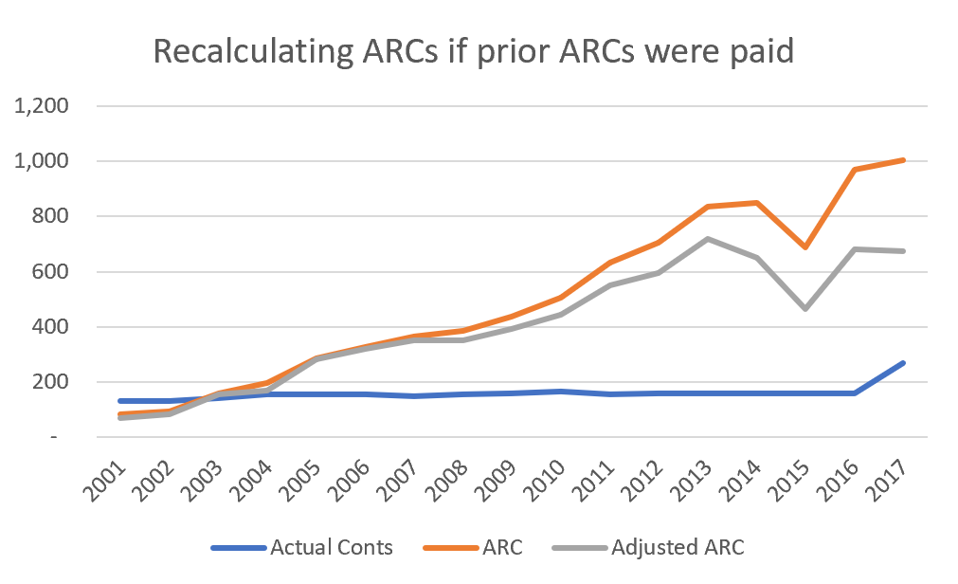
History of ARCs 2001 – 2017
own work
But that’s only the Municipal plan; without engaging in the full reconstruction (and FOIA requests) necessary to recreate the above chart, I have pulled together some basic data for the Police and Fire plans.
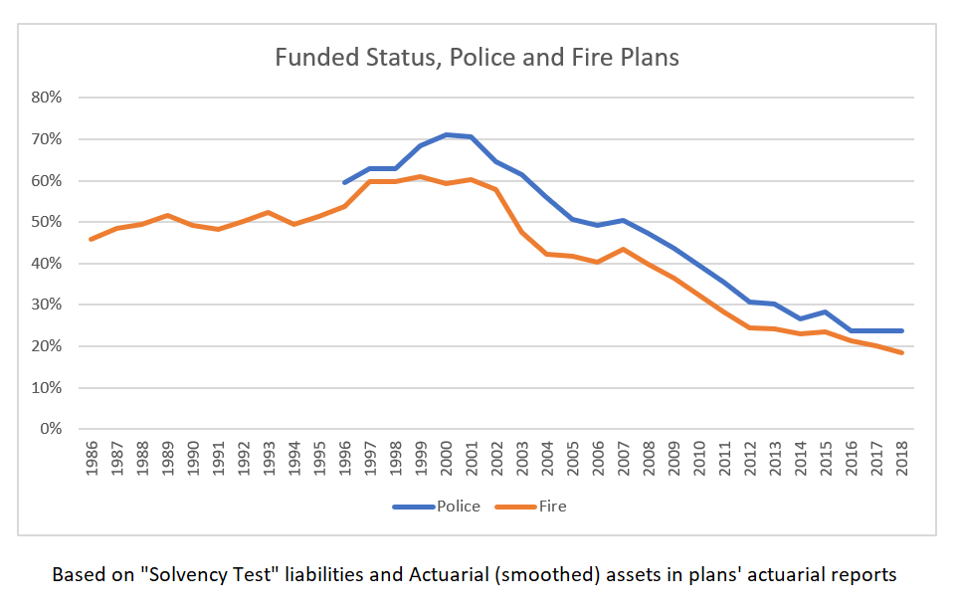
Chicago Police + Fire pensions’ funded status history
own work
In my January analysis, I sought to answer the question, “how did the Municipal Employees’ plan’s funded status drop so dramatically from its peak of nearly full funding in 2001?” But neither of these two plans ever made it as high as that – while that same year was more-or-less the peak funding year for both of these plans, the highest funded status these plans ever attained was 71% in 2000 – 2001, for the Police, and hovering-at-60% from 1997 – 2001, for the Fire plan.
At the same time, actual city contributions are likewise available in the posted-online reporting going back as far as 1997. (Small disclaimer: before 2006, this includes a contribution for retiree medical, but this is a very small piece of the total.) Here I’m only showing contributions prior to the implementation of the “ramp” in 2015, to get a better understanding of past history and avoid the short-term distortion.
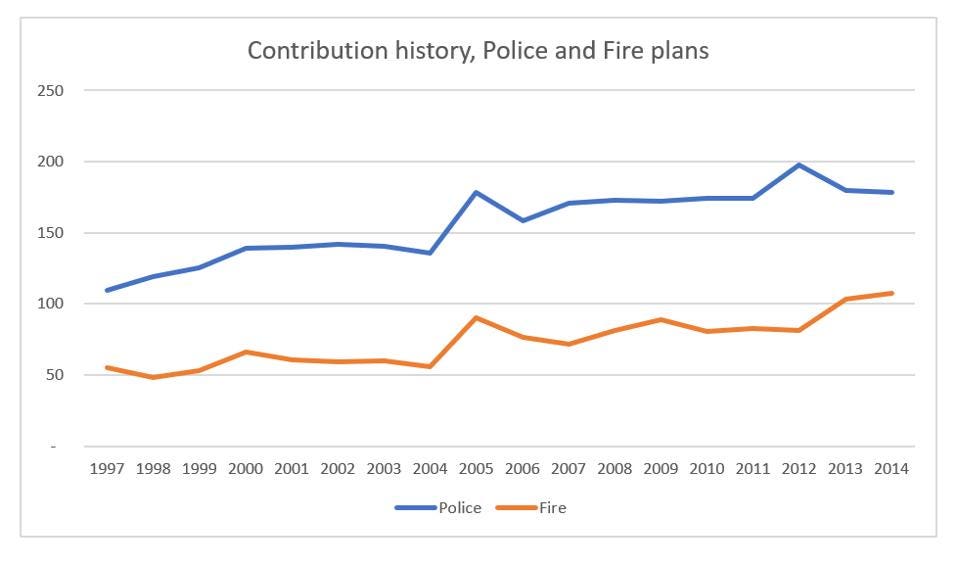
Police and Fire pensions contribution history, in billions.
own work
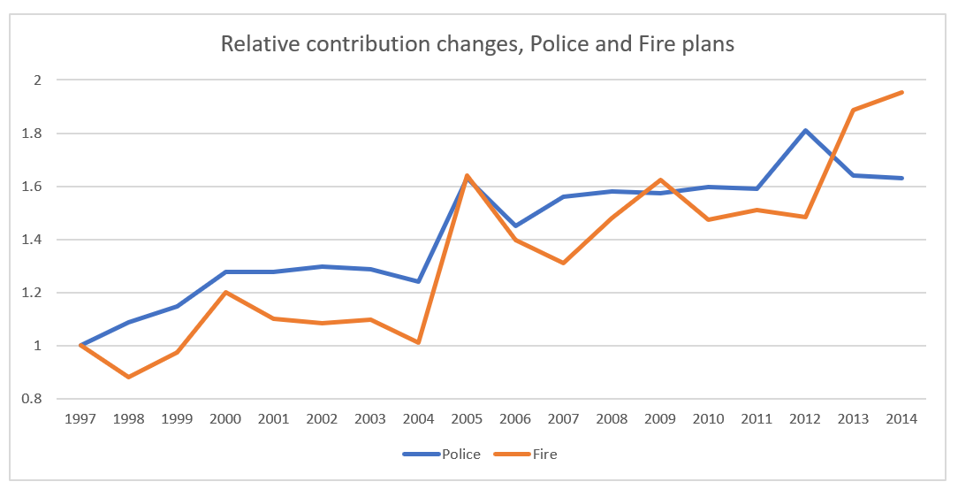
Chicago Police and Fire pensions’ contributions relative to 1997
own work
Looked at in terms of relative changes since 1997, the Fire plan’s contribution nearly doubled, and the Police contribution increased by 63%. Yes, there was some fluctuation, but no “contribution holidays” in the sense of entirely failing to pay contributions. In fact, whether by coincidence or by design, over this 18-year period, for both plans, whether considering the total sum in nominal amounts or adding in expected asset returns, the contributions very nearly match the amounts as if the city had increased their contributions by the expected annual increase in payroll (that is, using the assumed 3.5% for Fire and 3.75% for Police in the 2018 valuations) – which is not a surprise given that the contributions were based on a “multiplier” approach that should increase in this fashion, but goes against the narrative of contribution cheating.
Now, again, there are multiple factors in move from low to the present catastrophically-low levels of funding: demographic impacts, benefit increases, and the relentless impact of asset losses and assumption and experience losses, in a plan where an asset return rate as high as 8% make the plan very vulnerable when the asset return isn’t achieved. (And, at the same time, the Municipal Employees’ plan achieved its short-lived almost-full-funding with a combination of both very favorable asset returns and increases in the asset return assumption itself.)
But there is nothing that suggests that in the recent past the city has deliberately shorted the pension plans; clearly there’s no pattern that can tie the crash in funding levels to a decline in contributions.
What the funded status and funding patterns do suggest, however, is that, at their inception and for many subsequent years, these plans were never really intended to be any more than partially funded – and by the time everyone involved acknowledged that, indeed, true efforts at funding were necessary, it was too late to reverse course without contribution hikes at levels so large that they themselves would cause howls from people with competing funding demands.
And, yes, I’ll go there: for years upon years, decades upon decades, the city’s firefighters and police officers bargained for wage and benefit increases via their unions. But they, too, saw underfunded pensions as so thoroughly ordinary and unexceptional that, so far as I can tell, it never crossed their minds to bargain for improved pension funding.
December 2024 Author’s note: the terms of my affiliation with Forbes enable me to republish materials on other sites, so I am updating my personal website by duplicating a selected portion of my Forbes writing here.
Forbes post, “Chicago Fire, Chicago Police, Chicago Pensions: Why A COLA Change Isn’t A Cure-All”
Originally published at Forbes.com on September 6, 2019.
Yes, I am certainly just one of many who get on their respective soapboxes about Chicago pensions (as I have been) and say, “a fixed 3% COLA is unsustainable when inflation is running at a rate far less than that.” But in the interest of being careful with the facts and avoiding misunderstanding, I owe readers an article clarifying what that particular fix will — and won’t — do.
To begin with, only the Municipal Employees’ and the Laborers’ plans have a compounding Cost-of-Living Adjustment for their Tier I employees. This was implemented as of January 1, 1999, at a point at which the plan had a 90% funded ratio due to the bull market of the late 90s. (Prior to this date, beginning in 1984, the COLA was 3% non-compounding, pre-1984, the COLA was 2% non-compounded.) The change from a non-compounding to compounding COLA, at the time, “cost” a modest 5% increase in liabilities — however, the change was “cheaper” to implement that it would be today, because the valuation interest rate was 8% (now it’s 7%, which raises the relative value of the benefit payments further into the future), and because it used an older mortality table (if retirees are predicted to die sooner, the value of the compounding nature of the COLA is relatively less than with predicted longer life expectancies). If the same effect were calculated today, it might be more like 6 – 7%; in either case, it was not wildly reckless for the city to have provided this enhancement.
For Police and Fire, the story is different.
For both of these plans, future retirees receive a 1.5% annual adjustment, non-compounded, that is, always based on the original benefit. Those born before the year 1966 receive a 3% COLA, but it remains non-compounded. This benefit provision is much closer to the Tier 2 benefits that Municipal and Laborers’ participants (and teachers and state workers) have.
And the Police and Fire plans comprise almost exactly half the total liability (50.1%, to be precise, according to the CAFR).
What’s more, the benefits in the Police and Fire plans are as generous, or more, than the Municipal and Laborers’ plans, despite the lack of a compounding COLA; the Police, Fire, and Labobers’ plans each have benefit accrual rates (normal cost rates) of 19% of payroll while the Municipal Employees’ plan is only at 13%.
Why? These two plans have provisions for retirement at an age that’s significantly younger than even the Tier I Municipal Employees:
For the Fire and Police pension, age 50 if hired before 2011; age 55 (or 50 with a reduced benefit) if hired in 2011 or later.
For the Municipal Employees: age 60 if hired before 2011, or age 55 with reductions; age 67 (or 62 with a reduced benefit) if hired in 2011 or later.
That’s a lot of years of additional benefit! And, in order to provide a full-career-sized retirement benefit even with a shortened career, the per-year-of-service accrual factor is higher accordingly.
This makes a big difference, and the (let’s be honest) lower life expectancy isn’t enough to offset the early retirement ages.
Now, I’ll admit: I am not an expert in the health and well-being of firefighters or police officers at retirement, nor whether they’re able to work at a desk job, nor can I opine on the degree to which those individuals who retire at age 50 simultaneously collect their pension and work in the private sector — all of which factor into the question of exactly how much room there is for increasing the retirement age for these workers. Certainly, though, if an age 55 retirement age is deemed fair for the post-2010 hires, that seems to suggest that it’s at least a starting point for reform for the pre-2011 hires.
Is the city, are the aldermen and the mayor willing to ask the question of what the proper retirement age is, for police and firefighters? To ask for concessions? To limit retirees to a partial benefit for the early retirement years on the expectation that these former workers are still employed, though possibly at lower rates of pay?
So why is there so much focus on the COLA?
In part, because that’s the low-hanging fruit (to whatever degree something requiring a constitutional amendment can be labelled “low-hanging”); there’s no apparent harm done to anyone by trimming this benefit, and it’s simply not readily defensible to insist on keeping the fixed, compounded 3%.
Other cuts have a much more visible cost to them. Yes, it’s possible to eliminate cost-of-living adjustments entirely and cut liabilities as much as 20% (based on my own, simplified calculations), but some sort of inflation-compensating adjustment is generally recognized as appropriate for as long as these workers do not participate in Social Security. The benefit accrual rate is 2.4% for city workers, 2.5% for police and fire – might the city cut this, for future accruals and future pay increases, and by how much? Might the city apply the pensionable pay cap that’s already in force for the Tier 2 workers, to Tier 1 as well? Apply a cap to benefits already in payment? Increase the retirement age for Tier 1 workers and not just their Tier 2 counterparts?
There are plenty of options if an amendment is passed protecting the dollar-amounts of accrued benefits only, but each of them has more pain for the affected retirees and workers than an unwinding of the compounded COLA.
The bottom line? Eliminating the fixed compounding COLA is a great first step, but if it’s the only step, the improvement in funded status will be small.
Note on sources: each of the four entities has websites on which they make available their actuarial reports: the Police, Fire, Laborers’ and Municipal Employees’ plans. Each of the reports includes substantial detail, including history of the plan, that year’s results, and a 50-year projection of the plan financials on an “open plan” basis — and each of the reports includes strong language from the actuaries urging sounder funding. For three of the four, reports for the past decade are available; the Municipal Employees’ plan website provides actuarial reports dating back to the 1980 plan year, very handy for my January deep dive into the system.
December 2024 Author’s note: the terms of my affiliation with Forbes enable me to republish materials on other sites, so I am updating my personal website by duplicating a selected portion of my Forbes writing here.